
Read the Tide, Not Just the Waves: Why Sora Uses Three Timeframes
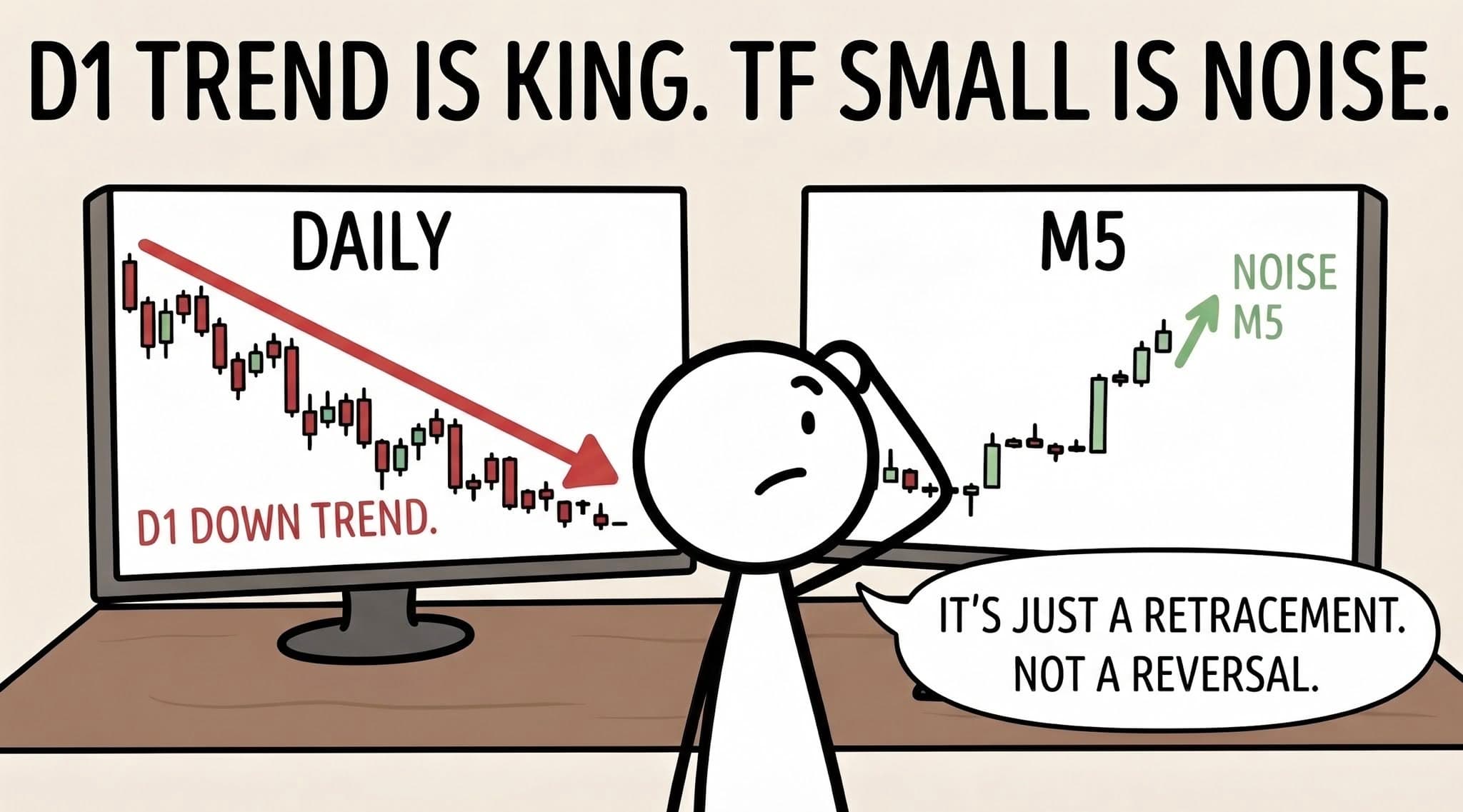
When I first started building Sora, I was impatient. I'd see a beautiful Engulfing candle on M5 and want it to jump in right away. It would enter, and then price would just drop. I sat there confused for a good while, until I scrolled over to D1. Oh… the big picture was a downtrend. That green candle on M5 was just price bouncing up for a breath on its way down, and I'd jumped on the wrong ride. (Can't blame the bot for that one. That's all on whoever wrote it.)
The problem is that a small timeframe only sees the waves, not the tide. So you need several timeframes looking together, each doing its own job. D1 shows the main current, because a daily candle swallows all the back-and-forth within the day and leaves only the real direction. H1 checks whether the trend is still moving the same way as D1 or is pulling back. And M5 finds the entry, because a small timeframe lets you place a tight SL, so you don't have to cut your Lot size down to almost nothing.
So Sora has a rule: D1 and H1 have to point the same way first, and only then does M5 look for an entry. It enters only when an Engulfing candle confirms that buyers have really stepped in right now. If any of them points the other way, the bot just sits still. That annoyed me at first. Watching a beautiful signal go by without the bot taking it, I'd missed the ride again. But when I went back over the test results, the trades it chose not to take were the ones that saved it most.
D1 shows the way, H1 says whether it's time, M5 says where to get in. Not trading is a decision too. By now the bot has more discipline than the person who wrote it, and that person still checks M5 at two in the morning. (The bot can sleep. I can't.)
Read the original post and join the conversation on Facebook.
Updated 7 October 2026
Still stuck? Email us at support@cloudpips.io and we'll help you sort it out.